
Two things make the dollar you see on a trade different from the dollar that hits your account: fees and slippage.
Fees
Your broker charges a small amount for opening and closing each contract. These charges are typically a few cents per contract per side and add up to a noticeable amount over a busy month.
You can choose how the portal shows them:
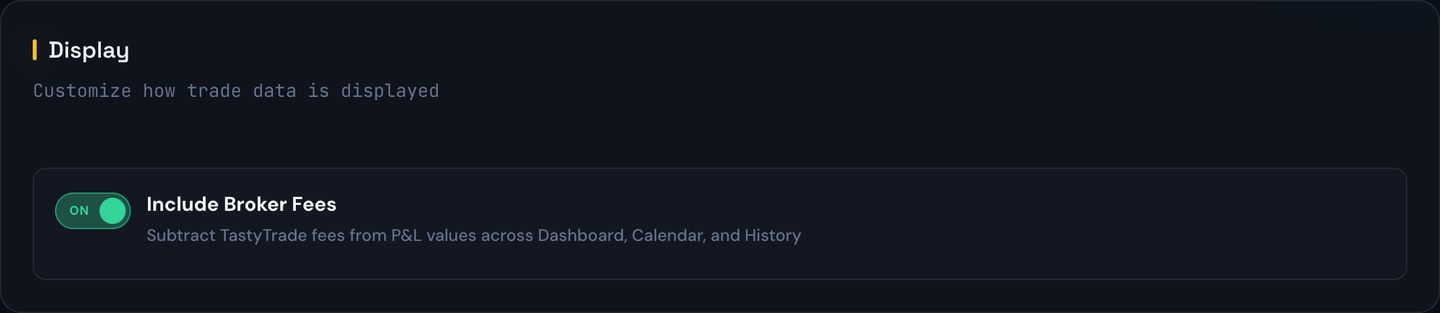
- Show broker fees ON — every P&L number is shown net of fees, the way the money actually arrives in your account.
- Show broker fees OFF — every P&L number is shown gross, before fees. Useful when you want to compare results to the original alert prices.
The toggle lives on the Dashboard Settings page. Switching it doesn't change anything about your trades — only the labels you read.
Note
The fee figure the portal shows is a close estimate built from your broker's published fee schedule. Your broker settles the exact amount after the close (it shows up on your statement), so a net number can move by a few cents once everything settles.
Note
Not every option costs the same to trade. Options on index products — like SPX or XSP — carry a small extra per-contract exchange fee that stock and ETF options don't, and they aren't discounted by the same per-trade commission cap. The portal accounts for this automatically per ticker, so an SPX or XSP trade shows slightly higher fees than a same-size SPY or QQQ trade.
Futures fees are a different shape
Futures don't work like options here. There's no percentage-of-value component at all — you pay a flat amount per contract each way, made of what your broker keeps (the commission), what the exchange charges, and a small regulatory fee.
Only the commission depends on your Tradovate plan, so that's the one thing the portal asks for: set Futures Commission Plan on the Dashboard Settings page to Free, Monthly, or Lifetime.
One /NQ contract opened and closed on the Free plan costs about $5.28 all in ($1.29 commission + $1.33 exchange + $0.02 regulatory, doubled for both sides). The micro version, /MNQ, is about $1.56 for the same round turn. On the Monthly plan those become $4.68 and $1.36.
Note
Because the options fee schedule charges a percentage of the trade's value, applying it to a futures contract produces a wildly wrong number — a single /NQ contract would show over $60 of "fees" on a trade that really cost $5.28. If you see anything like that on a futures trade, your app is out of date.
Note
This whole section uses Tradovate's published pricing. The portal doesn't have Plus500's commission schedule yet, so Plus500 trades show $0 in fees rather than a guessed number. That $0 means the fees aren't set up yet, not that Plus500 is free to trade.
Slippage
Slippage is the difference between the price the alert specified and the price your trade actually filled at. Markets move quickly; by the time your order reaches the exchange, prices may have moved a few cents.
Slippage can work for you or against you:
- Negative slippage — you paid more on entry (or got less on exit) than the alert price. Most slippage is small negative.
- Positive slippage — you got a better fill than the alert price. Rarer but it happens.
The portal tracks slippage automatically. Some dashboards include an Average Slippage card so you can see how your typical fills compare to the alert prices.
Example
An alert says "buy at $1.00." Your order fills at $1.02. That's -$0.02 of slippage per contract on entry. On 10 contracts, that's -$20 before the trade has done anything.
Tip
If your slippage is consistently large and negative, you may be trading during low-liquidity windows. Tightening your trading-hours filter is often the fix.
Slippage in the Backtest
The Backtest page has its own Slippage % control, and it means something more specific than the live tracking above: it's an extra haircut on top of whatever the Fills setting already charges.
- Under Bid/Ask (the default) — the backtest already buys at the ask and sells at the bid, which is the real spread a live order pays. Slippage on top of that is additional pessimism, so leave it at 0 unless you specifically want to model a fast-moving market costing you even more than the spread already does.
- Under Mid — every fill happens at the midpoint, so there's no spread being charged at all. Slippage is then the only entry cost the simulation applies.
Leaving Slippage above 0 while Fills is set to Bid/Ask charges the spread twice, so the Backtest page warns you when both are true. See Backtest for the rest of the Fills setting — Bid/Ask vs Mid, Entry Order, and Fill Timeout.