
Multi-tier trailing is the same idea as a regular trailing stop, but with several "tiers" of protection that activate one after another as the trade grows.
The idea: trail loosely while a trade is still small, then tighten the trail more and more as the profit grows. Loose early protection means you don't get shaken out by minor noise; tight late protection means you keep most of a big gain.
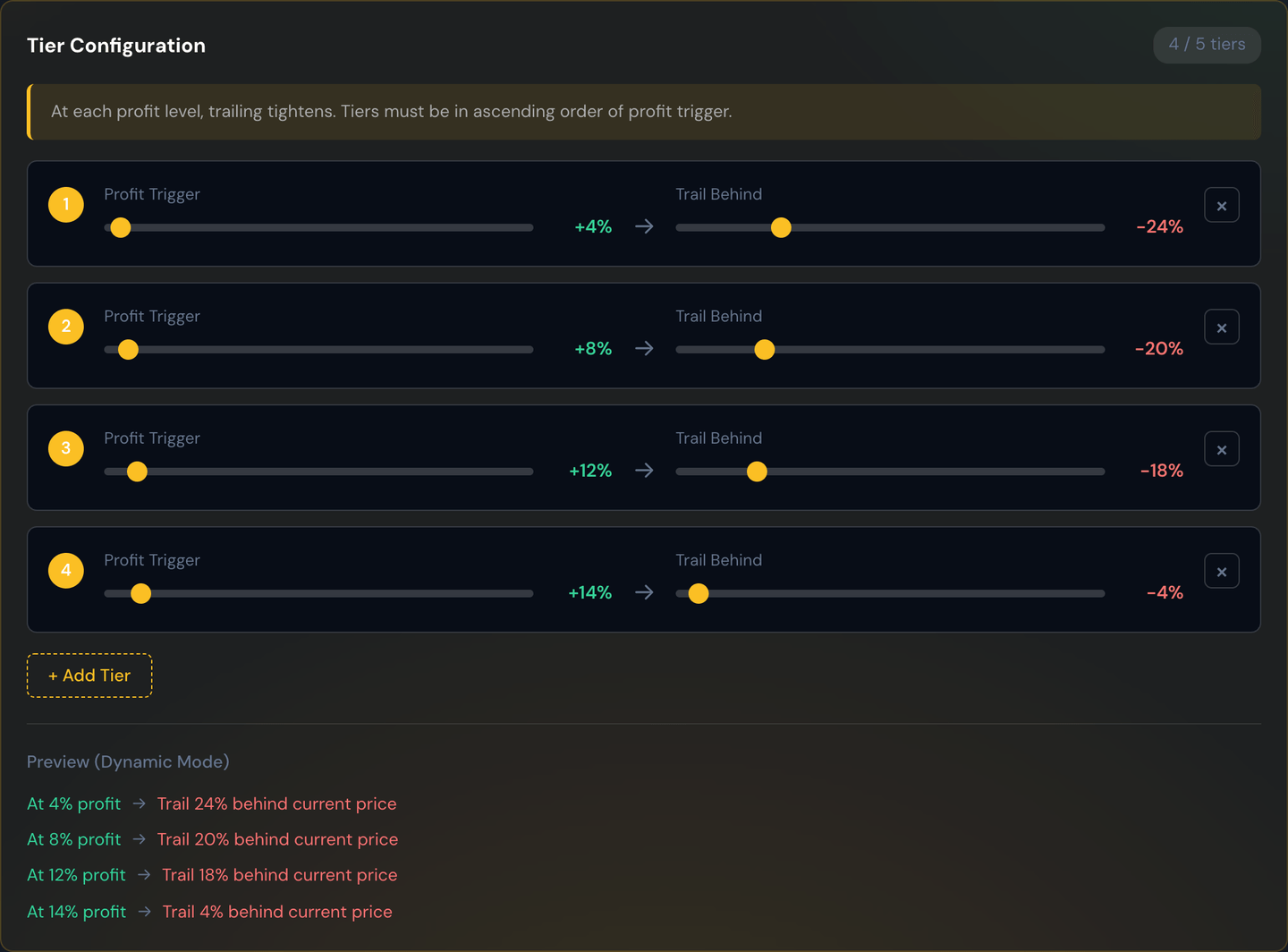
Reading the ladder
Each tier has the same two ingredients as a regular trailing stop:
- A trigger — how much in profit before this tier becomes the active one.
- A trail — how far behind the peak this tier sits.
Higher tiers always have a higher trigger and a tighter trail than the one below.
Worked example
A three-tier ladder might look like this:
| Tier | Trigger | Trail |
|---|---|---|
| 1 | +20% | 15% |
| 2 | +50% | 10% |
| 3 | +100% | 5% |
Walking through it on a trade entered at $1.00:
- Price hits $1.20 → Tier 1 activates with a 15% trail.
- Price hits $1.50 → Tier 2 takes over with a tighter 10% trail.
- Price hits $2.00 → Tier 3 takes over with the tightest 5% trail.
- Price pulls back. Whichever tier is currently active is the one that fires when the trail is breached.
You keep wide protection on a normal-sized move, and you give back almost nothing on a home-run move.

On futures
The ladder works exactly the same way on a futures contract, but every rung is a distance rather than a percentage — because a percentage of an index price is far too small to read. Each tier block shows the trail distance and the "@" trigger in whichever unit you picked for Futures P&L Unit in Dashboard Settings, ticks unless you've changed it.
So a ladder that reads T0 · 40t · @30t means: once the trade is 30 ticks in profit, the stop starts following 40 ticks behind the peak. Same idea as the options example above, counted in ticks instead of percent. See Trailing Stop for more on how futures distances are displayed, including why a box occasionally shows a dash.
Tip
A multi-tier ladder is the most you'll usually want to think about per trade. Start with two tiers if a three-tier setup feels confusing — you can always add a third later.